

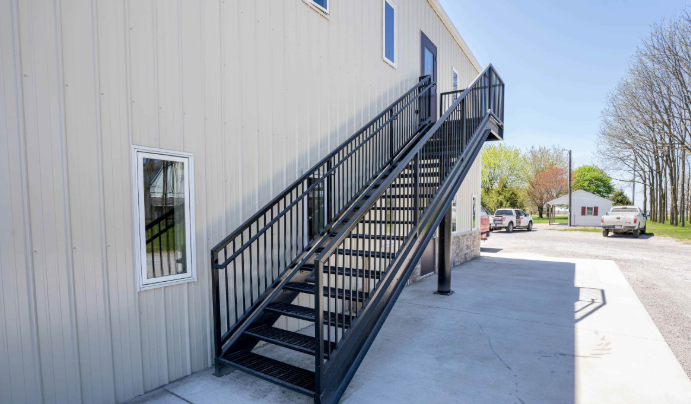
Commercial Metal Stairs in Houston: What Property Owners Should Know
Learn what Affordable commercial metal stairs cost in Houston, how heavy-duty welding works, and how to hire a certified fabricator. Includes materials, codes, and FAQ.
Every commercial building needs safe vertical circulation. In Houston, Texas, that means metal stairs that handle heavy foot traffic, meet strict building codes, and survive Gulf Coast humidity. Whether you are outfitting a warehouse near the Port of Houston, a medical office in the Texas Medical Center, or a retail space along Westheimer Road, the stairs you install must be built to last. We have worked with property owners across Harris County who need heavy-duty metal structure welding for stair towers, fire escapes, and mezzanine access.
Commercial metal stairs are not off-the-shelf products.
They are engineered assemblies that combine structural steel, precise welding, and code-compliant detailing. According to Angi (2026), professional welding costs $60 to $125 per hour, with most projects averaging $500 . A full commercial stair fabrication and installation job runs far higher because it involves engineering, material procurement, and field welding under AWS standards.Top commercial metal stairs cost in Houston
Why Houston Properties Choose Commercial Metal Stairs
Houston’s commercial landscape demands durability. The city sees 50 inches of rain per year, summer humidity above 80 percent, and the occasional hurricane. Wood rots. Concrete cracks. Metal stairs with proper welding and coatings stand up to all of it.
Stair Types and Materials: What Fits Your Building
Not every commercial stair serves the same purpose. The occupancy type, load requirements, and aesthetic goals all drive material selection.Right commercial metal stairs cost in Houston
Bar grating stairs are the choice for industrial settings.
The open treads let spills, rain, and debris fall through. Welded steel grating is strong and slip-resistant. These stairs are common in petrochemical facilities and distribution centers along Highway 290.
Ornamental steel stairs combine function with appearance.
Custom railings, curved stringers, and specialty finishes make these suitable for client-facing spaces. The welding here is as much aesthetic as structural. Every joint must be ground smooth and finished to match the design intent.
Aluminum stairs work where weight or corrosion is a concern.
Rooftop access stairs, coastal properties, and chemical plants often specify aluminum. The trade-off is lower load capacity and higher material cost.
Stainless steel is the premium option.
It resists corrosion without coatings and meets sanitary standards for food service and healthcare. A medical office near the Texas Medical Center might specify stainless for interior stair towers to match clean-room aesthetics.
How Fabricators Build and Install Commercial Metal Stairs
A professional stair project moves through distinct phases. Skipping any step risks code violations or structural failure.
Phase one is engineering and detailing.
The fabricator reviews architectural drawings, calculates loads per IBC Section 1005, and creates shop drawings. For Houston projects, engineers must account for wind loads from the International Building Code with local amendments . The Houston Building Code requires structural steel to comply with AISC 360 standards .
Phase two is material procurement and cutting.
Steel is ordered to specification, cut to length, and staged in the shop. For heavy-duty jobs, fabricators use plasma or laser cutting for precision. JK Welding in Houston notes that in-house CNC cutting protects geometry and speeds fabrication .
Phase three is shop welding.
Stringers, treads, and platforms are assembled in a controlled environment. Welders hold AWS D1.1 certification for structural steel. Every weld is inspected visually. Critical joints may receive ultrasonic or magnetic particle testing.
Phase four is surface preparation and coating.
Steel gets shot-blasted to SSPC-SP6 standards. A zinc-rich primer goes on first, followed by an epoxy intermediate coat and a urethane topcoat. In Houston’s humid climate, this three-coat system is the minimum for exterior stairs.Best commercial metal stairs cost in Houston
Phase five is delivery and field installation.
Large stair sections arrive on flatbed trucks. A crane or forklift places the assembly. Field welders connect sections and attach the stair to the building structure. Final inspection confirms railings, handrails, and tread dimensions meet code.
What Commercial Metal Stairs Cost in Houston
Pricing depends on material, complexity, and whether the job is shop-fabricated or field-welded. In 2026, Houston commercial metal stairs follow these ranges.
For standard steel pan stairs, budget $150 to $300 per linear foot installed. A two-story exit stair with 20 treads might run $8,000 to $15,000. Bar grating industrial stairs cost $200 to $400 per linear foot. Ornamental and stainless systems reach $400 to $800 per linear foot.
How to Choose the Right Metal Stair Fabricator in Houston
Texas does not require a state welding contractor license . Houston does not require general contractor registration . That makes your own screening essential.
Verify AWS certification.
Structural welding for commercial stairs requires welders certified under AWS D1.1 for steel or D1.2 for aluminum. Ask for welder qualification records. These documents show which processes and positions each welder is approved for.
Check City of Houston fabricator certification.
The city maintains a registered list of structural steel fabricators authorized to produce load-bearing components within city limits . Certified fabricators submit a certificate of compliance at project closeout. Using an uncertified shop triggers mandatory third-party special inspections that add cost and delay.
Demand proof of insurance.
General liability of at least $1 million is standard for commercial welding. Workers compensation is optional in Texas for private employers but strongly recommended . Most commercial clients and general contractors require it.
Look for local experience with commercial stairs.
A fabricator who handles commercial metal stairs in Houston — like JB Fences — will know the local building department requirements for structural steel, understand the humidity and salt-air challenges of Gulf Coast installations, and carry the trade-specific insurance that general handymen often skip .
Request a written scope.
The document should list material grades, coating systems, weld inspection criteria, and warranty terms. Vague quotes lead to change orders.
Conclusion
Commercial metal stairs are a long-term investment in safety and function. In Houston, that means choosing materials and a fabricator who understand Gulf Coast humidity, local building codes, and the demands of heavy commercial use. Start by defining your occupancy type and load requirements. If you want a local team that handles heavy-duty metal structure welding and knows the City of Houston certification process, reach out to JB Fences for a detailed quote and material consultation. We can walk you through options for your property without pressure.Expert commercial metal stairs cost in Houston
Frequently Asked Questions
What do commercial metal stairs cost in Houston, TX?
Standard steel pan stairs run $150 to $300 per linear foot installed. Industrial bar grating stairs cost $200 to $400 per linear foot. Ornamental and stainless systems reach $400 to $800 per linear foot.
What materials are best for Houston’s humid climate?
Steel with a three-coat paint system or hot-dip galvanizing works for most applications. Aluminum resists corrosion without coatings and suits rooftop or coastal access. Stainless steel is the premium choice for sanitary or high-visibility interiors.
Do I need a certified welder for commercial stairs in Houston?
Yes. Structural steel stairs require AWS D1.1 certified welders. The City of Houston requires structural fabricators to be on its registered list or face mandatory third-party inspections .
How long does it take to fabricate and install commercial metal stairs?
Shop fabrication takes two to four weeks for standard designs. Custom ornamental work takes six to eight weeks. Field installation takes one to three days depending on crane access and building conditions.
What building codes apply to commercial stairs in Houston?
The Houston Building Code adopts the International Building Code with local amendments. Stairs must comply with IBC Section 1005 for means of egress and AISC 360 for structural steel design .
Can metal stairs be added to an existing building?
Yes. Field welding and bolted connections allow retrofit installation. The existing structure must be evaluated for load capacity. A structural engineer should review anchor points and landing supports.
What is the difference between pan stairs and bar grating stairs?
Pan stairs have solid steel treads filled with concrete. They feel solid and dampen sound. Bar grating stairs have open treads that let light and water pass through. They are lighter and better for industrial environments.
How do I maintain exterior metal stairs in Houston?
Inspect coatings annually for rust or peeling. Touch up damaged areas promptly. Pressure wash salt deposits if the stair is near the Ship Channel or coastal areas. Lubricate hinge points on access gates.
Does Houston require special inspections for metal stairs?
The City of Houston waives third-party shop inspections for fabricators on its certified list . Field welding may still require special inspection depending on the project scope and occupancy type.
What load capacity do commercial metal stairs need?
IBC requires stairs to support a minimum live load of 100 pounds per square foot for most occupancies. Industrial stairs may need 125 psf or more depending on use. Your engineer calculates the exact requirement.
Can ornamental metal stairs meet code?
Yes. Custom designs can meet all structural and egress requirements. The challenge is balancing aesthetics with handrail height, tread depth, and load capacity. Experienced fabricators engineer beauty into compliance.
Should I choose welded or bolted stair construction?
Welded joints are stronger and require less maintenance. Bolted connections allow field adjustment and faster installation. Many commercial stairs use a hybrid approach: shop-welled main frames with bolted railings and treads.
Standard steel pan stairs run $150 to $300 per linear foot installed. Industrial bar grating stairs cost $200 to $400 per linear foot. Ornamental and stainless systems reach $400 to $800 per linear foot.
Steel with a three-coat paint system or hot-dip galvanizing works for most applications. Aluminum resists corrosion without coatings and suits rooftop or coastal access. Stainless steel is the premium choice for sanitary or high-visibility interiors.
Yes. Structural steel stairs require AWS D1.1 certified welders. The City of Houston requires structural fabricators to be on its registered list or face mandatory third-party inspections .
Shop fabrication takes two to four weeks for standard designs. Custom ornamental work takes six to eight weeks. Field installation takes one to three days depending on crane access and building conditions.
The Houston Building Code adopts the International Building Code with local amendments. Stairs must comply with IBC Section 1005 for means of egress and AISC 360 for structural steel design .
Yes. Field welding and bolted connections allow retrofit installation. The existing structure must be evaluated for load capacity. A structural engineer should review anchor points and landing supports.
Pan stairs have solid steel treads filled with concrete. They feel solid and dampen sound. Bar grating stairs have open treads that let light and water pass through. They are lighter and better for industrial environments.
Inspect coatings annually for rust or peeling. Touch up damaged areas promptly. Pressure wash salt deposits if the stair is near the Ship Channel or coastal areas. Lubricate hinge points on access gates.
The City of Houston waives third-party shop inspections for fabricators on its certified list . Field welding may still require special inspection depending on the project scope and occupancy type.
IBC requires stairs to support a minimum live load of 100 pounds per square foot for most occupancies. Industrial stairs may need 125 psf or more depending on use. Your engineer calculates the exact requirement.
Yes. Custom designs can meet all structural and egress requirements. The challenge is balancing aesthetics with handrail height, tread depth, and load capacity. Experienced fabricators engineer beauty into compliance.
Welded joints are stronger and require less maintenance. Bolted connections allow field adjustment and faster installation. Many commercial stairs use a hybrid approach: shop-welled main frames with bolted railings and treads.